
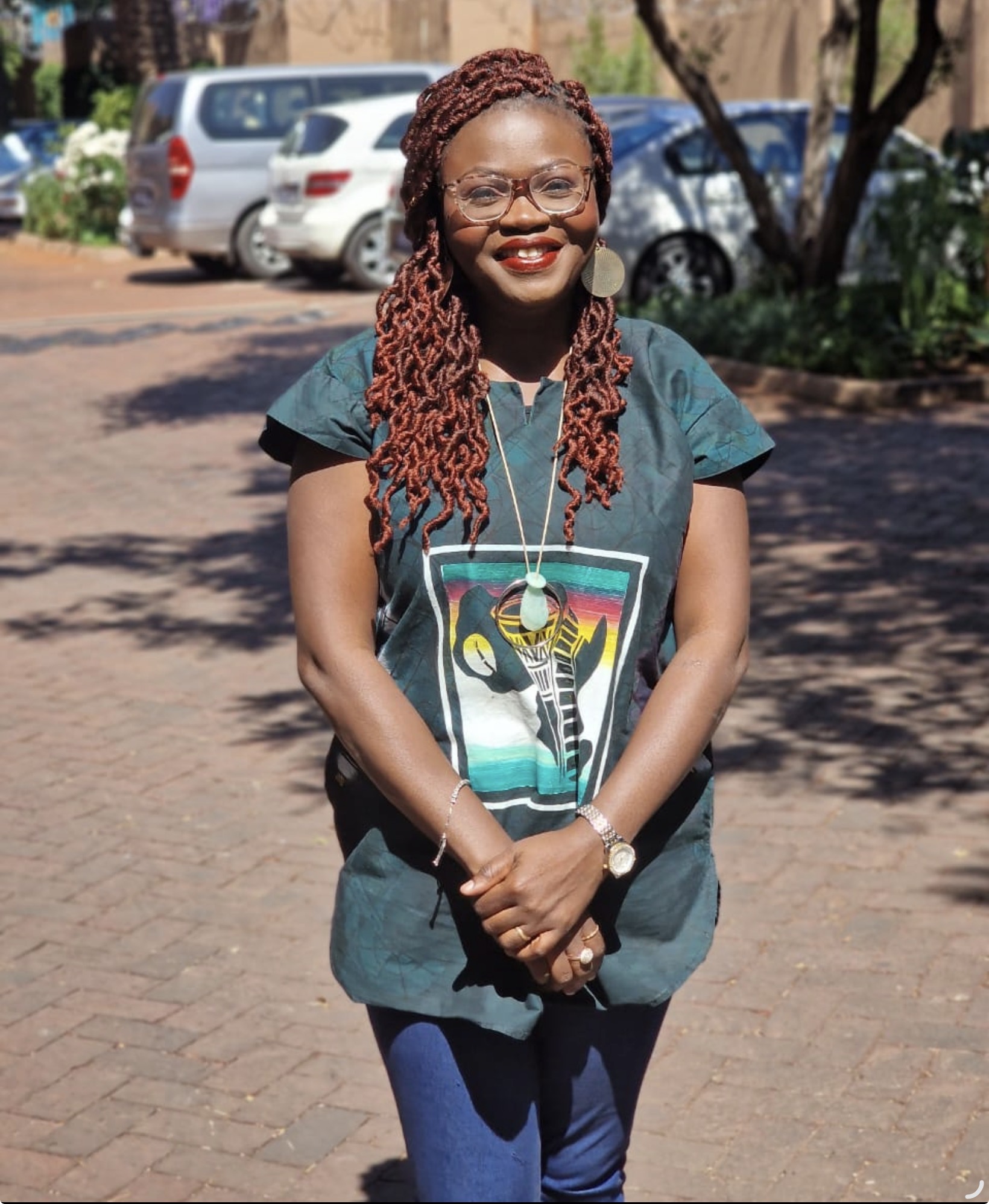
Angelina Wilson Fadiji
Dr Wilson Fadiji’s research centres on psychological well-being and positive mental health, with a particular focus on African contexts. Her work explores how individuals—especially young people in socioeconomically deprived settings—cultivate resilience and thrive despite adversity. She is especially interested in developing contextually grounded theoretical frameworks for understanding well-being in Africa, moving beyond universalised models to foreground culturally embedded experiences and values.
Her research spans a range of topics including meaning in life, relational well-being, hope, life satisfaction, and culturally specific conceptions of happiness. Through both empirical and theoretical contributions, she aims to advance a more inclusive and culturally responsive psychology of well-being..
Her current research projects include an exploration of wellbeing and character strength in Shotokan karate practitioners; my primary research area is hoarding and hoarding behaviours although she is interested in a number of topics related to wellbeing, nature connectedness and applied research which aims to support and improve the lives of various groups including people with hoarding difficulties and victim-survivors of domestic abuse
Academic publications
Cowden, R. G., Fadiji, A. W., Govender, K., Hendriks, H. J., Schoeman, W. J., Case, B., … & VanderWeele, T. J. (2025). Flourishing in South Africa: Benchmarks and sociodemographic variation across 69 health, wellbeing, and related factors in the Global Flourishing Study. International Journal of Wellbeing, 15(3).
Meiring, L., van Eeden, R., & Wilson Fadiji, A. (2025). A qualitative study on the feasibility of a yoga-based PPI for promoting well-being at a South African HEI. SA Journal of Industrial Psychology, 51, 2249.
Wilson Fadiji, A., Lomas, T. (2024). Understanding the Association Between Education and Wellbeing: An Exploration of the Gallup World Poll. Applied Research Quality Life. https://doi.org/10.1007/s11482-024-10335-8
Wilson Fadiji, A, Itumeleng P. Khumalo, Marié Philipina Wissing, and Richard Appiah (2024). “A bibliometric review of positive psychology and well-being research in Africa.” Frontiers in Psychology, 15: 1384362.
Khumalo IP, Selvam SG, Wilson Fadiji A. (2023). The well-being correlates of religious commitment amongst South African and Kenyan students. South African Journal of Psychology. 53(4):589-602. Doi:10.1177/00812463231199960
Cromhout, A., Schutte, L., Wissing, M. P., Wilson Fadiji, A., Guse, T., & Mbowa, S. (2023). Psychometric properties of the Harmony in Life Scale in South African and Ghanaian samples. African Journal of Psychological Assessment, 5, 122.
Wilson Fadiji, A., de la Rosa, P. A., Counted, V., De Kock, J. H., Bronkhorst, W. L. R., Joynt, S., … & Cowden, R. G. (2023). Flourishing During the COVID-19 Pandemic: A Longitudinal Study. South Africa. Psychological Reports.
Wilson Fadiji, A., Luescher, T., & Morwe, K. (2023). The dance of the positives and negatives of life: student wellbeing in the context of# feesmustfall-related violence. South African Journal of Higher Education, 37(2), 1-25.
Khumalo, I. P., Appiah, R., & Wilson Fadiji (2022). A. Measuring positive mental health and depression in Africa: A variable-based and person-centred analysis of the dual-continua model. Frontiers in Psychology, 3570.
Wilson, A., Khumalo, I. P., & Mpofu, E. (2021). Meaning in Life Among Ghanaian University Students: Does Religious Commitment Matter? Journal of Religion and Health, 1-18.
Wilson Fadiji, A. & Khumalo, I. (2021). Family values and social well-being: Do motives for activities mediate? Current Psychology. https://doi.org/10.1007/s12144-021-01740-5.
Mahali, A., Swartz, S. & Wilson Fadiji, A. (2021). Covid has created some other opportunities’: cautious optimism among young African graduates navigating life in a time of pandemic. Youth Voice Journal.
Appiah, R., Wilson Fadiji, A., Wissing, M. P., & Schutte, L. (2021). The Inspired Life Program: Development of a multicomponent positive psychology intervention for rural adults in Ghana. Journal of Community of Psychology. https://doi.org/10.1002/jcop.22566
Luescher, T., Wilson Fadiji, A., Morwe, K. & Letsoala, T. (2021). Rapid photovoice as a close-up, emancipatory methodology in student experience research: The case of the student movement violence and wellbeing study. International Journal of Qualitative Research Methods, 20.
Appiah, R., Wilson Fadiji, A., Wissing, M.P. & Schutte, L. (2021). Participants’ experiences and impressions of a group-based positive psychology intervention programme for rural adults in Ghana. International Journal of Qualitative Studies on Health and Well-being, 16(1).
Wilson Fadiji & Reddy, J. (2021). School and individual predictors of mathematics achievement in South Africa: the mediating role of learner aspirations. African Journal of Research in Mathematics, Science and Technology Education, 1-12.
Wissing, M. P., Wilson Fadiji, A., Schutte, L., Chigeza, S., Schutte, WD., & Temane, M. (2020). Motivations for relationships as sources of meaning: Ghanaian and South African experiences. Frontiers in Psychology.
Appiah, R; Schutte, L. Wilson Fadiji, A.; Wissing, M. P. & Cromhout, A. (2020). Factorial Validity of the Twi Versions of Five Measures of Mental Health and Well-Being in Ghana. PLOS ONE .
Appiah, R; Wilson Fadiji, A.; Schutte, L.; & Wissing, M. Effects of a Community-based Multicomponent Positive Psychology Intervention on Mental Health of Rural Adults in Ghana. Applied Psychology: Health and Well-being.
Wilson, A. & Reddy, V. (2020). Understanding learners’ educational aspiration in South Africa: The role of home and the school. South African Journal of Education, 40(2).https://doi.org/10.15700/saje.v40n2a1712 .
Cooper A., Mokomane, Z. & Wilson, A. (2020) Relationship between social policy and multi-dimensional well-being: an analysis of the South African Child Support Grant. Transformation: Critical Perspectives on Southern Africa 102, 73-94. Doi:10.1353/trn.2020.0003.
Wilson Fadiji, A., Meiring, L., & Wissing M. P., (2019). Understanding well-being in the Ghanaian context: Linkages between lay conceptions of well-being and measures of hedonic and eudaimonic well-being. Online first at Applied Research in Quality of Life https://doi.org/10.1007/s11482-019-09777-2
Khumalo, I., Wilson Fadiji, A., & Brouwers. (2019). Well-being orientations and time perspective across cultural tightness-looseness latent classes in Africa. Online first at Journal of Happiness Studies https://doi.org/10.1007/s10902-019-00151-5.
Wilson, A. Wissing, M. P., Schutte, L., & Kruger, I. M. (2018). Understanding goal motivations in deprived contexts: Perspectives from a rural South African community. Applied Research in Quality of Life. https://doi.org/10.1007/s11482-017-9583-y
Wilson, A., Wissing, M. P, Ndima L. (2018). Representations of hope, goals and meaning from lay person’s perspectives in two African contexts: A qualitative study. Journal of Humanistic Psychology. https://doi.org/10.1177/0022167818785070
Mahali A., Lynch, I., Wilson Fadiji, A. & Tolla, T. (2018). Networks of well-being in the global south: A review of current scholarship. Journal of Developing Societies, 34(4).
Wilson, A. Wissing, M. P., & Schutte, L. (2018). “We help each other”: Relational patterns among older individuals in South African samples. Applied Research Quality Life 14, 1373–1392, https://doi.org/10.1007/s11482-018-9657-5.
Wilson, A., & Somhlaba, N. (2017). The position of Ghana on the progressive map of mental health: A critical perspective. Global Public Health 12(5), 579-588. Doi:/10.1080/17441692.2016.1161816.
Wilson, A. & Somhlaba, N. Z. (2017). Ghanaian school-going adolescents’ self-perceived barriers of access to quality education: A qualitative study. Development Southern Africa. https://doi.org/10.1080/0376835X.2017.1324763.
Wilson, A. & Somhlaba, N. Z. Gender, age, religion and positive mental health for adolescents in a Ghanaian socio-cultural context (2017). Child Indicators Research. https://doi.org/10.1007/s12187-017-9495-2